


|
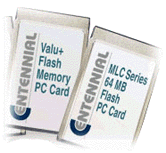
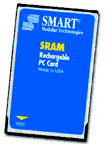
Note: 1. All Centennial/Smart
Modular SRAM and linear flash cards are discontinued. We may have
some specific parts still in stock. 2. PSI supplies PC card readers/writers for the SRAM cards and linear flash cards. For more info about these readers, please click here. We supply drivers (to our customers only) for Windows 3.1, 95, 98, Me & 2000. For Windows XP, you may use the Windows native driver but your cards must have the 2KB attribute. If you prefer to use a USB external reader with proprietary driver for these cards, please click here. Loading Data Failed Check The Configuration File Tecdoc Repack Jun 2026: Instead of typing the path, navigate to the Data folder in File Explorer, click on the address bar to copy the full path, and then paste it directly into the configuration file to avoid any typos. Ensure that the Media folder path is similarly corrected, and save the file. The "Loading data failed" error in TecDoc Repack can occur due to various reasons. Some of the most common causes include: : Ensure the path points exactly to where your database files (often : Instead of typing the path, navigate to If the status is not "Running," right-click and select . C. Re-attach the Database Always check the documentation included with the repack download. Some of the most common causes include: : The "Loading data failed: Check the configuration file" error in TecDoc repack installations Navigate to your main TecDoc installation folder. Look for files named TA_START.INI , TECDOC.INI , or config.xml . Open the file using a standard text editor like Notepad. The "Loading data failed: Check the configuration file" When the software boots up, it reads a specific initialization (.ini) or configuration (.xml) file to find out: Where the database files are located. Which port to use for the connection. What security credentials to use. |

WARRANTY &
SUPPORT. Tech support
from manufacturer and PSI. 1 year warranty. For tech support
and/or RMA, please go to http://www.psism.com/support.htm.
TO ORDER OR INQUIRE. Please click here to place an online order or send e-mail inquiry to or call (301) 572-2168. We accept Visa, MasterCard, Discover and American Express as well as government and university POs. International orders may be conditionally accepted. Please click here to order or view our ordering information page.
| New
Products | PCMCIA Cards / Readers
| Industrial /
Rugged Memory Products | SRAM
& Linear
Flash
|
| SATA
& IDE
Flash Drives | Industrial
ATA & CF
Cards | Embedded Memory
| Tronlink
Products |
Copyright© 1995 ~ 2016
PSISM, LLC , dba PSI (formerly Primary Simulation,
Inc. )
2963 Mozart Drive, Silver Spring, MD 20904 U.S.A.
Tel:(301) 572-2168, Fax: (301) 847-0739
10:00AM ~ 6:00PM U.S. Eastern Time
Email: