Sony Vaio Pcg61211m Specification !link! Jun 2026
All About Digital Photos

Sony Vaio Pcg61211m Specification !link! Jun 2026

can suffer from fan dust buildup and overheating. You can easily remove the bottom cover to access the processor fan and heat sink, allowing you to clean the fan and apply fresh thermal paste.

Powered by the integrated Intel HD Graphics . While not designed for modern, high-end gaming or intensive 3D rendering, it is more than capable of handling high-definition video playback, basic photo editing, and casual gaming. 💾 Memory and Storage One of the best aspects of the PCG-61211M is its capacity for hardware tweaks.

1366 x 768 (HD) or 1600 x 900 (HD+), depending on the specific sub-model.

Lithium-Ion (VGP-BPS22), typically offering around 3 to 3.5 hours of life when new. 🚀 Modern Upgradability

ATI Mobility Radeon HD 5145 with 512 MB dedicated video memory. Operating System: Originally shipped with Windows 7 Home Premium (64-bit) 🔌 Connectivity & Ports 3x USB 2.0 ports. Video Out: 1x HDMI and 1x VGA. Data/Special: 1x e-SATA port and 1x ExpressCard/34 slot. Networking: sony vaio pcg61211m specification

, was a prominent entry in Sony's E Series lineup during the early 2010s. Combining the aesthetic flair typical of the VAIO brand with balanced mid-range performance, this 14-inch laptop was designed for home and office users who valued both style and functionality. Core Processing and Architecture At the heart of the PCG-61211M Intel Core i3-330M processor , a dual-core chip with a base clock speed of

: Wi-Fi (802.11b/g/n), Gigabit Ethernet (RJ-45), and Bluetooth 2.1 + EDR.

The is a model from Sony’s renowned VAIO series, positioned as a portable, everyday Ultrabook. While exact commercial naming varies by region (often associated with the VAIO S series or T series), the PCG prefix typically identifies a specific motherboard and chassis revision.

Sony VAIO PCG-61211M: Full Specifications, Features, and Upgrades can suffer from fan dust buildup and overheating

At the heart of the PCG-61211M is the Intel Core i3-350M processor. This dual-core CPU, clocked at 2.26 GHz, was a staple of the Arrandale architecture. While it lacked the "Turbo Boost" technology found in its i5 and i7 siblings, it utilized Hyper-Threading to manage four threads simultaneously. This made the laptop particularly adept at multitasking between web browsers, office suites, and media players—the primary use cases for its target demographic. Supporting the processor was 4GB of DDR3 RAM, which was the "sweet spot" for Windows 7 Home Premium, the operating system it originally shipped with. This memory configuration ensured that the system remained responsive under standard workloads, though the motherboard's support for up to 8GB allowed for some degree of future-proofing.

in 2014, this specific machine remained a testament to the brand's focus on multimedia. With its built-in ATI Mobility Radeon HD 5145

Memory and storage Typical configurations shipped with 512 MB to 1 GB of DDR SDRAM soldered or installed in SO‑DIMM slots; higher-end SKUs could be configured with 2 GB. For the time, 1 GB was common for smooth web and office usage; heavier multitasking or media editing benefited from 2 GB where supported. Storage was a 2.5-inch SATA or PATA hard disk drive, commonly between 60 GB and 120 GB capacity. The optical drive was usually a combination DVD±RW or DVD-ROM drive, enabling software installation and DVD playback.

Upgradeability and maintenance The machine allowed basic upgrades: RAM could be increased by replacing/adding SO‑DIMMs (subject to chipset limits), and the hard drive could be swapped for a larger capacity drive. Optical drives were usually removable or replaceable. CPU upgrades were limited by the laptop’s socketed or soldered CPU and BIOS support—most users upgraded memory and storage rather than the processor. Serviceability followed common mid-2000s practices: access panels for RAM and HDD made simple repairs possible but full disassembly required careful handling. While not designed for modern, high-end gaming or

is a robust, stylish legacy laptop. While its specs are outdated for heavy productivity or gaming, it remains an excellent choice for a dedicated, low-cost media station, a typing-focused notebook, or a secondary machine for basic tasks.

Here is the complete content for the specifications, formatted for a product page, manual, or tech reference.

Suggest that run well on older hardware. Share public link

Replacing the mechanical hard drive with a provides the biggest performance boost. It eliminates long boot times and frozen application screens. Note that the interface is SATA II, so the SSD speed will max out around 270 MB/s, which is still significantly faster than the original drive. 2. RAM Upgrade

The Sony VAIO PCG-61211M Go to product viewer dialog for this item.

The (frequently marketed under the model number VPCEB1M0E or part of the VAIO EB Series ) remains a classic example of Sony's golden era of laptop design. Released in the early 2010s, this 15.6-inch laptop was engineered as a versatile everyday entertainer, balancing multimedia performance with a highly distinctive aesthetic.

 
Changing the DPI

DPI vs PPI - please note that references here to DPI (Dots Per Inch) actually means PPI (Pixels Per Inch). I continue to use DPI since that's still how many people (incorrectly) understand it. And with some software (i.e. most scanning software), you'll still see DPI used where PPI is what is actually meant. DPI (meaning printer dots per inch) is essentially an obsolete term. But it's still in very common use as a term to mean PPI. See What is DPI. At some point I'll change all my DPIs to PPIs - but that's another project for another day :-)


If you've come here after reading my article "The Myth of DPI" you'll already know that DPI has nothing to do with digital image resolution or quality. However, some people and places who are still ignorant of that fact (many graphics designers, magazines and print shops) still insist of getting a photo with an internal setting of ___DPI (usually 300 DPI) even when the photo's pixel resolution is sufficient to print the photo at the required PPI. The easy solution (rather than trying to educate them about real digital photo resolution) is to simply change the DPI setting of your image to whatever they want and send it along to them.

You may also wish to change the DPI so that the image will default size to the intended print dimensions when loaded into a word processor or desk top publishing program. For instance, if you want to set a 1500 pixel wide photo so that it will default to a 4 inch print dimension, then change the DPI setting of the photo to 375 DPI (1500 pixels divided by 4 inches = 375 pixels per inch).

The trick when changing the DPI is to do it without resizing (resampling) your image in the process. You want to change the DPI while retaining the original pixel dimensions (the real digital resolution) of the photo. I'll provide three examples, one using Adobe Photoshop (Windows & mac) and the other two using the free programs XnView (Windows, Linux & mac) and Irfanview (Windows).

Note that this procedure will not change the digital photo in any way other than to alter the internal DPI setting. The size and resolution of the digital image will be unchanged.

XnView Method
    sony vaio pcg61211m specification
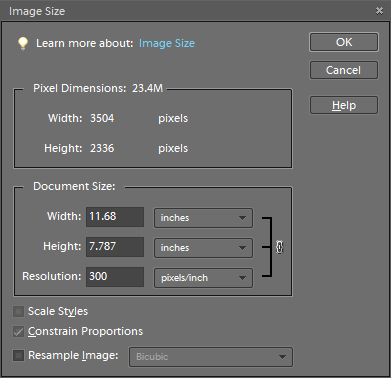
    note that the "Resample Image" box is UNCHECKED and that the "Print Size" has been set to 300
  1. Open a folder with images and select an image to show full view.
  2. Select the "Image > Resize" menu option (not the "set DPI" option)
  3. In the image size dialog window, deselect the "Resample Image" checkbox (make sure there is no checkmark in that box).
  4. In the "Resolution" box type in 300 (or whatever DPI you want)
  5. Click the "OK" button
  6. Your image DPI has now been set to whatever you want (leaving the pixel dimensions of the image unchanged).
  7. Save this photo with a new name - I suggest adding a -300dpi extender (i.e. "345-2365-300dpi.jpg") to identify this new DPI image.
  8. See note below when saving to JPEG format
Earlier versions of XnView had a bug in which the DPI change wasn't recognized by programs such as Adobe Photoshop. This was fixed in 2009, so any current version is fine. There is a direct "set DPI" option, but you have to make sure to adjust both the X and Y to identical values (only the X value will be recognized by Photoshop, I'm not sure what happens with the Y, hence best to stick with the "Resize" dialog).
Adobe Photoshop Method
    adobe - change dpi
    note that the "Resample Image" box is UNCHECKED
    and that the "Resolution" has been set to 300
  1. Load your image into Adobe Photoshop (or Photoshop Elements).
  2. Select the "Image > Image Size" menu option (may be "Image > Resize > Image Size" in Photoshop Elements).
  3. In the image size dialog window, deselect the "Resample Image" checkbox (make sure there is no checkmark in that box).
  4. In the "Resolution" box type in 300 (or whatever DPI you want)
  5. Click the "OK" button
  6. Your image DPI has now been set to whatever you want (leaving the pixel dimensions of the image unchanged).
  7. Save this photo with a new name - I suggest adding a -300dpi extender (i.e. "345-2365-300dpi.jpg") to identify this new DPI image.
  8. See note below when saving to JPEG format

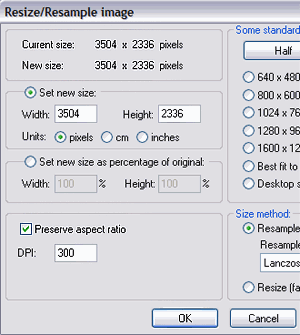
Irfanview Resize Image Dialog Box
Irfanview Method
  1. Load your image into Irfanview
  2. Select the "Image > Resize/Resample" option
  3. In that dialog window you'll see a specific DPI data box
  4. Simply enter whatever DPI you want without adjusting anything else in that dialog window.
  5. Click on the "OK" button
  6. Your image DPI has now been set to whatever you want (leaving the pixel dimensions of the image unchanged).
  7. Use "Save As" to save this photo with a new name - I suggest adding a -300dpi extender (i.e. "345-2365-300dpi.jpg") to identify this new DPI image.
  8. See note below when saving to JPEG format

Saving to JPEG - please note that JPEG is a digital photo format that uses variable compression - that is, you can change the compression. Your camera should (if you have it set correctly) be using low compression (highest quality). To emulate this when doing a "save as" from a photo program, choose a compression of about 95 (Adobe Quality 10+).

If you are using XnView, when you do a JPEG save, click on the "Options" button to give you the JPEG save dialog and move the slide towards "Best" to whatever number (i.e. 95) you wish. Using Irfanview, when you do a "Save As" in JPEG format, note the dialog box with the JPEG options - move the slider to 95 (or higher if you wish) for best image quality. With Adobe Photoshop (incl. Elements) - choose quality 10 or higher in the dialog box that comes up when you do a Save As in JPEG format.

A verification is to check the image filesize (in kilobytes or megabytes) of your copy of the photo against the original digital photo. They probably won't be identical, but should be close. If there is a big discrepancy in filesize then you've done something wrong.

Other Programs

Other photo programs are going to have a similar process. The key is to make sure that the image IS NOT being resampled (pixel resized) when the DPI is changed. As long as the pixel dimensions remain unchanged, your new DPI photo will be identical to your original photo, only the internal DPI setting of the photo will have been changed. Your print shop, graphics designer or magazine should be happy campers with your "new higher DPI" image.


Home   •   What Is | Filetypes | Colour Models | Acronyms and Nomenclature | Frequently Asked Questions (FAQ)   •   Storage   •   Digital Labelling | Visible Captioning   •   What Is DPI | Myth DPI | Change DPI   •   Changing Size   •   Print Shops | Arithmetic of DPI | FAQ | Photoshop Dialog Box   •   Home Printing | Print Shops   •   Geotagging   •   Scanning   •   Digital Images and Genealogy | Make Your Photos Last Forever | Camera or Scanner | Copying Old Photos | Workflow Examples | Visible Captioning | Choosing a Camera | Print Longevity | Sending Photos to Relatives

Comments: send me email:

URL: www.rideau-info.com/photos/changedpi.html
© 2003- Ken W. Watson